
Thursday, October 14, 2010


Bank Reposessions Top 100,000 In A Month For The First Time Ever

September marked the 19th straight month that the number of filings topped 300,000, and the first month in which 100,000 repossessions were logged.
As usual, a small number of states dominated the national foreclosure figures, accounting for more than half of all repossessions.
- California : 17% of all repossessions
- Florida : 13% of all repossessions
- Michigan : 7% of all repossessions
- Arizona : 7% of all repossessions
- Texas : 5% of all repossessions
- Georgia : 5% of all repossessions
Thankfully for home sellers, mortgage servicers appear to be metering the pace at these newly bank-owned homes are made available to the public. RealtyTrac notes that, in doing so, servicers prevent "the further erosion of home prices".
That said, distressed properties still sell at a steep discount.
In the second quarter of 2010, the average sale price of homes in the foreclosure process was 26 percent lower than the average sale price of homes not in the foreclosure process. It's no surprise, therefore, that, based on RealtyTrac's preliminary data, 31 percent of all homes sold in September were "distressed".
There's lot of good deals out there, in other words, but they come with certain risks.
Buying a foreclosed home is not the same as buying a non-foreclosed home. Specifically, you're buying from a corporation and not from a "person". Contracts may vary, and so may terms.
Therefore, home buyers -- even experienced ones -- should talk with a real estate agent before making an offer. It's important to understand the foreclosure-buying process.
Wednesday, October 13, 2010
The New Foreclosure Mess - What it Means to You.

Today, we want to explain what is actually taking place and what impact the situation may have on you and your family over the next several months.
Currently, many banks have ceased foreclosure procedures in all states which require a judicial process. California does not require a judicial process. You can find out whether your state requires such a process by visiting All Foreclosure.com which lists foreclosure procedures by state. It is our belief that all fifty states will eventually be impacted by the controversy.
How will it impact you?
That depends on where you are in the real estate process. We will look at three situations: your home is in foreclosure, you are selling or you’re buying a foreclosure.
You are a homeowner in the foreclosure process
It appears that some banks will be backing away from following through with normal foreclosure processes until they can be assured that their paperwork is in order. Early estimates are calling for a potential 30-90 delay to many foreclosure procedures (notices, repossessions, sales, etc.) However, there is absolutely no way for anyone to be sure whether your particular situation will be delayed.
You are currently selling a house
We have reported often on the affect foreclosures have on home prices in a community. The actual impact is measurable.
According to RealtyTrac, bank-owned properties went for an average of 35% less than non-foreclosure sales. Foreclosures not only absorb buyers but also impact the appraisals of the homes that surround them.
Obviously, if there are less distressed properties coming to the market, there will be less downward pressure on pricing in the short term. The Washington Post, in an article last week, reported:
Stretching out the foreclosure process would reduce the number of houses dumped on the market over the next six months, which could help firm up housing prices in the short term and put some extra support under a sagging economyThere may be a window of opportunity for a seller to maximize the price they receive for their home if they sell in the next 90 days.
You are currently buying a foreclosure
A portion of the inventory of foreclosed homes on the market has been frozen. Banks and title companies (who insure good title to the property a buyer purchases) want to make sure the bank actually owns the property legally before they sell it. The Washington Post in an article last week reported:
If you are buying a foreclosure, anticipate potential delays. We do not believe there will be large numbers of cancellations. Be patient and realize that you are getting a substantial savings on the purchase.
Nick Chaconas, a Maryland real estate agent, said he was one week from completing a foreclosure deal for one client, who was buying a $470,000 fixer-upper in Potomac, when an e-mail arrived putting the deal on the skids.
The e-mail, from the title insurance company involved in the deal, said the mortgage lender PNC was suspending foreclosure sales for at least 30 days “due to a review being undertaken on all foreclosure files.”
How long will the challenge persist?
The impact this will have on the housing recovery will be determined by both the depth and width of the challenge. Are there large numbers of homes that were mistakenly foreclosed on? We doubt it. Will the instances where errors (or even fraud) did exist cause mass delays? Maybe.
How will it impact the market overall?
Even though the impact will be the least in California because we are not a judicial state. There could be widespread ramifications. The Washington Post in an article last week:
It would not help the recovery of the economy, or the real estate market, if the foreclosure process became so hopelessly tangled that banks and investors effectively lose the ability to recoup the remaining value of their collateral. That would provide some immediate financial relief to households facing foreclosure, but it would encourage many more homeowners to begin shirking their mortgage payments in the belief that they would also be able to avoid the consequences. The long term consequences of that would be that mortgage rates would be higher and mortgage loans would be smaller and harder to get.Bottom Line
As we said last week, fewer foreclosures coming to the market right now will mean prices will be less impacted. However, these properties will eventually come to market; if not now, than later. That will delay the housing recovery – perhaps for years.If class actions suits start to dominate this story, it could be a long time before we normalize the situation.
Fed Minutes Edge Mortgage Rates Higher

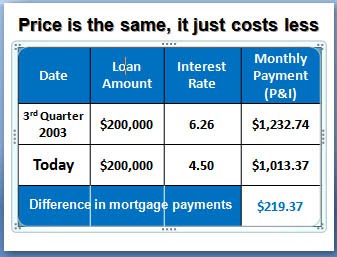
It's unwelcome news for this season's home buyers, and existing homeowners with plans to grab lower rates. Mortgage rates made new lows last week and may have reached a turn-around point.
The "Fed Minutes" is published 8 times annually, and is the official meeting recap for the Federal Open Market Committee. Similar to the meeting minutes released after a corporate conference or condo association gathering, the Fed Minutes details the conversation and debate between meeting attendees.
Minutes are the lengthy companion to the Fed's brief, post-meeting press release.
Because of its content, the Fed Minutes is closely read by Wall Street and economists. It's insight into the talk that shapes our nation's monetary policy and, within the text, there's often clues about the Fed's next move.
Here's some of what the Fed discussed last month:
- On inflation : It's running at lower-than-optimal levels
- On housing : Post-tax credit, housing stalled in July
- On stimulus : The Fed may intervene in open markets within the next few months
The over-riding theme within the minutes was that the U.S. economy is growing a steady pace, albeit slower than what's optimal. The Fed is prepared to push things along if the economy slows further and news like that is helping stock markets.
Bond markets are losing. Rates are rising.
For now, mortgage rates hover near all-time lows. If you haven't locked a mortgage rate yet, your window may be closing. Once the economy turns around for certain, mortgage rates will be among the first of the casualties.
Tuesday, October 12, 2010
Homeowner Maintenance : Twice-Annual Gutter Cleaning

In other words, keeping clean gutters is essential for homeowners. Thankfully, gutter maintenance can be a do-it-yourself job.
There are four main steps in gutter cleaning, summarized cleanly in this 4-minute video from Lowe's.
- Gather your tools. You'll need a ladder, a bucket, a hose, and a trowel.
- Scoop large debris from the gutter, using the trowel for hard-to-reach places smaller sticks and leaves
- Flush the gutters using a garden hose and spray attachment
- Remove clogs in the downspout and check for proper sloping
Gutter maintenance is a twice a year task and the Lowe's video offers helpful safety tips, too. Of course, if you're uncomfortable on a ladder, or prefer to hire a professional, reach out to me anytime.
I'm happy to make a local gutter-cleaning recommendation.
Friday, October 8, 2010
Jobs Data Shows Private Sector Growth, Hints At Lower Mortgage Rates

The report hit the wires at 8:30 AM ET this morning.
More commonly called "the jobs report", the government's non-farm payrolls data influences stock and bond markets, and, in the process, swings a big stick with home affordability figures nationwide.
Especially in today's economic climate.
Although the recession has been deemed over, Wall Street remains unconvinced. Data fails to show the economy moving strongly in one direction or the other and, absent job creation, economists believe growth to be illusionary.
Consider:
- With job creation comes more income, and more spending.
- With more spending comes growth in business
- With growth in business comes more job creation
And the cycle continues.
The prevailing thought is that, without jobs, consumer spending can't sustain and consumer spending accounts for two-thirds of the economy. No job growth, no economy recovery.
But there's another angle to the jobs report, too; one that connects to the housing market. As the jobs market recovers, today's renters are more likely to become tomorrow's homeowners, and today's homeowners are more likely to "move-up" to bigger homes. This means more competition for homes at all price points and, therefore, higher home values.
And that brings us to today's jobs data.
According to the government, 95,000 jobs were lost in September. Economists expected a net loss of 5,000. However, if public sector jobs are excluded from the final figures, jobs grew by 64,000. This is a positive for the private-sector, but still trailed expectations.
Wall Street is voting with its dollars right now and mortgage bonds are gaining, improving mortgage pricing.
So, although the September 2010 jobs report doesn't reflect well on the economy overall, home affordability around the country should improve as a result.


 Posts
Posts