
TO ALL THE KIDS WHO SURVIVED THE 1930's, 40's, 50's, 60's and 70's!!
First, we survived being born to mothers who smoked and/or drank while they were pregnant.
They took aspirin, ate blue cheese dressing, tuna from a can and didn't get tested for diabetes.
Then after that trauma, we were put to sleep on our tummies in baby cribs covered with bright colored lead-base paints.
We had no childproof lids on medicine bottles, locks on doors or cabinets and when we rode our bikes, we had baseball caps not helmets on our heads.
As infants & children, we would ride in cars with no car seats, no booster seats, no seat belts, no air bags, bald tires and sometimes no brakes.
Riding in the back of a pick- up truck on a warm day was always a special treat.
We drank water from the garden hose and not from a bottle.
We shared one soft drink with four friends, from one bottle and no one actually died from this.
We ate cupcakes made with Lard, white bread, real butter and bacon. We drank FLAV- OR- AID made with real white sugar. And, we weren't overweight. WHY? Because we were always outside playing....that's why!
We would leave home in the morning and play all day, as long as we were back when the streetlights came on. No one was able to reach us all day. And, we were OKAY.
We would spend hours building our go-carts out of scraps and then ride them down the hill, only to find out we forgot the brakes. After running into the bushes a few times, we learned to solve the problem.
We did not have Play stations, Nintendo's and X-boxes. There were no video games, no 150 channels on cable, no video movies or DVD's, no surround-sound or CD's, no cell phones, no personal computers, no Internet and no chat rooms.
WE HAD FRIENDS and we went outside and found them!
We fell out of trees, got cut, broke bones and teeth and there were no lawsuits from these accidents.
We would get spankings with wooden spoons, switches, ping pong paddles, or just a bare hand and no one would call child services to report abuse.
We ate worms and mud pies made from dirt, and the worms did not live in us forever.
We were given BB guns for our 10th birthdays, made up games with sticks and tennis balls and, although we were told it would happen, we did not put out very many eyes.
We rode bikes or walked to a friend's house and knocked on the door or rang the bell, or just walked in and talked to them.
Little League had tryouts and not everyone made the team. Those who didn't had to learn to deal with disappointment. Imagine that!!
The idea of a parent bailing us out if we broke the law was unheard of. They actually sided with the law!
These generations have produced some of the best risk-takers, problem solvers and inventors ever.
The past 50 years have been an explosion of innovation and new ideas. What can kids today do besides push buttons!
We had freedom, failure, success and responsibility, and we learned how to deal with it all.
If YOU are one of them, CONGRATULATIONS!
You might want to share this with others who have had the luck to grow up as kids, before the lawyers and the government regulated so much of our lives for our own good.
Kind of makes you want to run through the house with scissors, doesn't it?
Showing posts with label Ginger Proffitt. Show all posts
Showing posts with label Ginger Proffitt. Show all posts
Monday, November 1, 2010


Thursday, October 28, 2010
Ghost Cookies
GHOST COOKIES
 Here are the easiest cookies to make ever! Impress friends and family (it only takes a few minutes)
Ingredients:
1 lb white candy coating, chopped
1 pkg (1 lb) Nutter Butter cookies
Minature Chocolate Chips
Directions:
1. In a microwave-safe bowl, melt candy coating. 20 seconds, stir, repeat until smooth. Dip cookies into coating, covering completely. Place on waxed paper. 2. Brush ends with a pastry brush dipped in coating where fingers touched cookies. While coating is still warm, place two chips on each cookie for eyes. Let stand until set. Store in an airtight container.
 Here are the easiest cookies to make ever! Impress friends and family (it only takes a few minutes)
Ingredients:
1 lb white candy coating, chopped
1 pkg (1 lb) Nutter Butter cookies
Minature Chocolate Chips
Directions:
1. In a microwave-safe bowl, melt candy coating. 20 seconds, stir, repeat until smooth. Dip cookies into coating, covering completely. Place on waxed paper. 2. Brush ends with a pastry brush dipped in coating where fingers touched cookies. While coating is still warm, place two chips on each cookie for eyes. Let stand until set. Store in an airtight container.
Monday, October 25, 2010
Wednesday, October 20, 2010
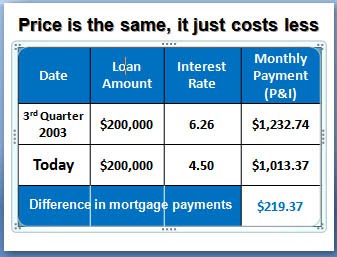
Price isn't the whole story when buying a house
Wow! Interest rates took another drop this week! We are at an all-time low.
Tuesday, October 19, 2010
5 Reasons You Should Sell Your House TODAY!

1. Entering this time of year, the buyers are more serious.
At this time of year, the ‘lookers’ are at the stores doing their holiday shopping. The home buyers left in the market are serious and are more apt to make a purchasing decision. Less showings – but to more motivated purchasers.
2. If you are moving up, you can save thousands.
Do the math; this might be the right time.A home that was once worth $300,000 may now be worth $240,000 in a market where prices have fallen 20 percent. Wow, you think, the seller is taking a bath. But that seller may also be a prospective buyer who wants a house that once was valued at $400,000. With an equivalent market drop and a realistic listing price, that house may now sell for $320,000. So, in effect, the person is losing $60,000 on the sale of one home but coming out ahead $20,000 on the purchase of another.Keep in mind the spread may be even greater.
3. Interest rates just fell again – to 4.19%. Professor Karl E. Case, the founder of the Case Shiller Pricing Index in an article in the New York Times last month actually did the math for us:Four years ago, the monthly payment on a $300,000 house with 20 percent down and a mortgage rate of about 6.6 percent was $1,533. Today that $300,000 house would sell for $213,000 and a 30-year fixed-rate mortgage with 20 percent down would carry a rate of about 4.2 percent and a monthly payment of $833 … housing has perhaps never been a better bargain.
4. You beat the rush of inventory that is coming next year. Every year there is an increase of inventory which comes to market from January through April as homeowners put their houses up for sale in preparation for the spring market. You won’t have to worry about this increasing competition if you sell now.
5. You have less ‘discounted’ inventory with which to compete. This year, sellers of non-distressed properties have been given an early holiday present. With banks declaring a suspension on the sale of many distressed properties (foreclosures), there has been a large supply of discounted properties removed from competition. No one knows how long this self imposed moratorium will last. However, while it does, every homeowner has a better chance of selling their property.
Bottom Line: If you are looking to sell in the near future, there may not be a more opportune time than this fall. Serious buyers, great move-up deals and less competition from foreclosures creates the perfect selling situation. Don’t miss it!
Thursday, October 14, 2010
Unemployed? Get a federal loan to pay your mortgage
Unemployed? Get a federal loan to pay your mortgage
Unemployed and can’t pay your mortgage? You soon can apply for a no-interest government loan for up to $50,000 to pay your mortgage and cover your arrears. The loan, which can offer assistance for up to two years, will be forgiven if the homeowner stays in the house for five years.
Read the entire story:
http://money.cnn.com/2010/10/05/news/economy/unemployed_mortgage_help/index.htm
Unemployed and can’t pay your mortgage? You soon can apply for a no-interest government loan for up to $50,000 to pay your mortgage and cover your arrears. The loan, which can offer assistance for up to two years, will be forgiven if the homeowner stays in the house for five years.
Read the entire story:
http://money.cnn.com/2010/10/05/news/economy/unemployed_mortgage_help/index.htm
Wednesday, October 13, 2010
The New Foreclosure Mess - What it Means to You.

Today, we want to explain what is actually taking place and what impact the situation may have on you and your family over the next several months.
Currently, many banks have ceased foreclosure procedures in all states which require a judicial process. California does not require a judicial process. You can find out whether your state requires such a process by visiting All Foreclosure.com which lists foreclosure procedures by state. It is our belief that all fifty states will eventually be impacted by the controversy.
How will it impact you?
That depends on where you are in the real estate process. We will look at three situations: your home is in foreclosure, you are selling or you’re buying a foreclosure.
You are a homeowner in the foreclosure process
It appears that some banks will be backing away from following through with normal foreclosure processes until they can be assured that their paperwork is in order. Early estimates are calling for a potential 30-90 delay to many foreclosure procedures (notices, repossessions, sales, etc.) However, there is absolutely no way for anyone to be sure whether your particular situation will be delayed.
You are currently selling a house
We have reported often on the affect foreclosures have on home prices in a community. The actual impact is measurable.
According to RealtyTrac, bank-owned properties went for an average of 35% less than non-foreclosure sales. Foreclosures not only absorb buyers but also impact the appraisals of the homes that surround them.
Obviously, if there are less distressed properties coming to the market, there will be less downward pressure on pricing in the short term. The Washington Post, in an article last week, reported:
Stretching out the foreclosure process would reduce the number of houses dumped on the market over the next six months, which could help firm up housing prices in the short term and put some extra support under a sagging economyThere may be a window of opportunity for a seller to maximize the price they receive for their home if they sell in the next 90 days.
You are currently buying a foreclosure
A portion of the inventory of foreclosed homes on the market has been frozen. Banks and title companies (who insure good title to the property a buyer purchases) want to make sure the bank actually owns the property legally before they sell it. The Washington Post in an article last week reported:
If you are buying a foreclosure, anticipate potential delays. We do not believe there will be large numbers of cancellations. Be patient and realize that you are getting a substantial savings on the purchase.
Nick Chaconas, a Maryland real estate agent, said he was one week from completing a foreclosure deal for one client, who was buying a $470,000 fixer-upper in Potomac, when an e-mail arrived putting the deal on the skids.
The e-mail, from the title insurance company involved in the deal, said the mortgage lender PNC was suspending foreclosure sales for at least 30 days “due to a review being undertaken on all foreclosure files.”
How long will the challenge persist?
The impact this will have on the housing recovery will be determined by both the depth and width of the challenge. Are there large numbers of homes that were mistakenly foreclosed on? We doubt it. Will the instances where errors (or even fraud) did exist cause mass delays? Maybe.
How will it impact the market overall?
Even though the impact will be the least in California because we are not a judicial state. There could be widespread ramifications. The Washington Post in an article last week:
It would not help the recovery of the economy, or the real estate market, if the foreclosure process became so hopelessly tangled that banks and investors effectively lose the ability to recoup the remaining value of their collateral. That would provide some immediate financial relief to households facing foreclosure, but it would encourage many more homeowners to begin shirking their mortgage payments in the belief that they would also be able to avoid the consequences. The long term consequences of that would be that mortgage rates would be higher and mortgage loans would be smaller and harder to get.Bottom Line
As we said last week, fewer foreclosures coming to the market right now will mean prices will be less impacted. However, these properties will eventually come to market; if not now, than later. That will delay the housing recovery – perhaps for years.If class actions suits start to dominate this story, it could be a long time before we normalize the situation.
Monday, October 4, 2010
Wednesday, September 15, 2010
What's Going On In The Market?
I have been getting so many emails and phone calls lately with questions about Real Estate recently that I have decided to put together a brief video each week answering some of the questions. If you have a specific question just let me know and I will include it in the upcoming weeks.
Wednesday, September 8, 2010
Confused about Condo's?

There are four types of condo structures that I am going to describe. They are free standing condos, duplex condos, townhouse condos and stacked condos.
Free-standing condos or “detached” condos (also call PUD's)are essentially a house on a small lot. No walls connect a free-standing condo to another structure i.e. the name “free-standing.” Typically this type of structure does not share walls, yard or insurance with others in the condo regime. Generally speaking, the HOA fees are negligible and usually owners have more autonomy than in other types of condo regimes. The reason for free-standing condos is a reduction in the lot size means that a house of similar size would be less expensive than a single family resident on a regular lot.
Duplex condos typically share one wall with another structure/owner and many times the shared wall is the garage. They usually have a yard and are similar to free-standing except for the one-shared wall. Many times a duplex condo is desirable for an owner who wants to live in the inner city but can’t afford the price tag of a single family residence in an urban and highly desirable location. Once again, owners do not share insurance and the HOA fees are negligible.
Townhouse condos typically share 1-2 walls and look like “row or garden style” homes. The owners share common areas including the costs associated with common area maintenance and insurance. Because of these shared costs HOA dues are usually higher and there is usually less control over what you can and cannot do with the exterior of the property.
Stacked condos typically share 2+ walls and are often called mid-rise or high-rise buildings. There is the potential for all four walls to be shared with someone living above, below and next to you on both sides. Once again, owners share insurance and common areas such as pool, fitness center, and any other community amenities. Because of this the HOA dues are higher and owners have little control of changes to the exterior of the property.
So, you might ask, “Why does any of this matter?” In my search for condo clarity I realized that it matters for both buyers and sellers. A lack of understanding about the nuances and benefits of each of these different structures limits a buyer’s opportunity to buy which in turn affects sellers. Additionally, in the current market, there is a perception that HOA’s are “bad” or take “advantage” of owners. While this might be the case in some situations, the majority of condo situations can be highly advantageous to certain types of buyers.
For example, a free-standing condo gives a buyer the opportunity to purchase a home in a highly desirable area that they might not otherwise be able to afford. With that, they have a smaller yard to maintain, lower utility bills, low maintenance fees, low HOA fees and still maintain a high level of autonomy as an owner.
My advice? Don’t be afraid to explore condos. They might be the perfect solution to living in an area that you might not otherwise be able to afford. And for those seeking lower maintenance, lower utilities and less yard work, a condo might just be the way to go.
If you still have questions please submit them as a comment.
Tuesday, September 7, 2010
DEAL OF THE MONTH
Who do you know who is thinking of buying or selling a house? Here is one of the best buys in town. It was just reduced and the seller is motivated. If you know someone who is looking for a 4 bedroom custom home with a little land let me know.
Friday, September 3, 2010
FINDING YOUR DREAM HOME IS JUST THE BEGINNING

For some home buyers, finding that perfect dream home is much more complicated than others. Do you need room for horses? An extra long motorhome? Lots of privacy while still in the city? Finding the perfect property can take a tremendous amount of effort and time, and required extensive research and diligence on my part. There are many homes that aren’t on the multiple listing service or on one of the 1001 home listing websites that a good agent will know about. We sell a lot of off market homes to buyers that they could never have found online, but other times clients call us and say, “Hey, we found the perfect home. We would like to buy it.” This is often when the difficult part of our job begins.
So how do you find an agent who can not only help you find your house, but also help you buy it- aka close escrow? There are a number of things you should look for:
- A skilled negotiator: The entire contract process involves a series of negotiations, even after the contract is ratified and you are in escrow. Your neighbor’s cousin who is an agent may be sweet, but can they save you money, time and aggravation by negotiating successfully for you? This doesn’t mean you hire someone who negotiates just to hear themselves negotiate which can lead to a failed purchase- a contract falling out of escrow. Negotiating successfully involves a series of give and take to reach the desired end result- a home purchase within the budget and time requirements.
- An educated real estate professional: Have they taken classes beyond the pitifully small amount required to get a real estate license? I took all of my licensing courses online. Quite honestly, the process was a joke. When I finished my licensing, my real education began. It was by trial and error that some lessons were learned. I quickly figured out I needed agent and took extensive course work to make sure I had the skills needed to do my job. Make sure your agent gets ongoing education- this business isn’t standing still. Ask them how they stay up to date on current rules and trends.
- A business professional: She should treat you, service providers, and other agents with professionalism and respect. A good agent will not bad mouth her competition, nor her other clients, even if it is deserved.
- An organizer: Your agent is essentially your project manager to get your transaction closed. Nobody wants a sloppy project manager. A missed deadline in a contract could mean the loss of not only the transaction, but possibly an earnest money deposit for you. An average earnest money deposit is not chump change.
- Trustworthy: Are they looking out for your best interests? We talk our clients out of buying homes we think are a bad investment all the time. Make sure your agent will do the same.
- Mobile: If your agent can’t assist you while out in the field, they can’t work for you the majority of the time. Successful agents are not in their offices. Find someone who is mobile and can assist you on the go.
- Tech Savvy: If your agent is mobile, they are probably not a technological neanderthal. This is a good test. Your agent doesn’t have to be a tech guru but they need to be up to date on the latest tech tools to not only help you find your house, but manage the transaction process along the way.
- Local: We see many failed transactions with out of area agents. The majority of out of area agents don’t know the intricacies of the individual county, city and even subdivision rules that can impact a home purchase and later on, a home’s resale value. Hire a local agent who knows not only the rules and regs, but also has a pulse on the local real estate market and knows the local agents who will be influencing the transaction process.
- Good with the numbers: Buying a home can very emotional, but it is also a major financial purchase. Your agent should be providing you comparable sales and comprehensive real estate market stats, charts & reports to help guide your decision making process, and should be giving you informed advice about the value of the home.
Your agent may not be the person who finds you the dream home, but a great agent will help make the complicated home buying process successful, no matter who found the property.
Thursday, September 2, 2010
Should I Refinance?

So the big question is, "Should I refiance?" Here are some things to consider:
1. Does it make financial sense?
If you are considering a “rate/payment reduction” refinance, I typically recommend that people do one simple calculation. Divide your monthly savings into the costs (out-of-pocket expenses AND any increase in your principal balance). That number will tell you how many months’ payments it will take to “break even”. Depending on how long you anticipate staying in the home, and comparing that to your “break even” month, will give some idea to what is the right decision.
2. What about a refinance to shorten the term of a mortgage?
When examining the possibility of cutting years off your mortgage, you should take a good hard look at how such a move can affect your monthly cash flow. If your payment stays the same and you save a few years of payments, many people will choose that option (rather than the monthly savings of a “rate/payment reduction” refinance). However, if your payment is going up (in order to save years), take time to analyze the impact on your monthly activities. Will you be sacrificing too much to save payments 20 year from now?
3. What will my home appraise for?
This is the biggest challenge facing most people. With so many homes underwater, there are many people who won’t be able to refinance. If you have an FHA loan, there is some hope if you qualify for their “Streamline Refinance Program” because there is an option to close the loan without an appraisal. (For a 15 minute video explaining the program, go to www.Facebook.com/FHAStreamlineRefinances ) For others, loan-to-value issues can create the need for Mortgage Insurance when it didn’t before (making “savings” harder to achieve). Understand that most lenders require you to pay for an appraisal (and maybe an application fee too) when you submit your loan request, so do your best to have a real sense of what your home will appraise for.
If you need the name of a lender you can trust, give me a call, I have several.
Saturday, August 21, 2010
Where are home prices headed?

Three of the major housing price indexes:
Altos Research:
“The market, right now, is a veritable case study of the law of supply and demand. Right now, there’s a whole lot of supply, but very, very little demand. The buyers that drove a flurry of activity during the spring have left a deafening silence in their wake … Increases in inventory nationwide show that demand simply isn’t there. As the market continues to correct itself, and as we head into the seasonally weak fall and winter months, expect more increases in inventory, and likely deepening declines in asking prices.”
Radar Logic:
“It is our belief that housing prices will decrease in the autumn, perhaps precipitously, and that may cause a second dip in the U.S. economy … And home buyers are not demonstrating any perceivable confidence that we have found the bottom, yet. As we begin to see the data for the fall, we expect it will be soft, that volumes and prices will move lower … If we are right, the odds of a double dip in the economy may well be more than one in four.”
Mark Fleming, chief economist for CoreLogic:
“Home price volatility and collateral risk remain very high. The stabilization phase and policy intervention since the spring of 2009 has run its course. Prices are expected to further moderately decline as the economy remains weak through the fall.”
Two other housing experts:
Ethan Harris, coordinator of global economics at Bank of America Merrill Lynch:
“I don’t think the housing market will double-dip. What we’re seeing in housing is a bottoming out at very low levels of activity. So, we expect a very long U-shaped recovery in housing in the next year or two. We expect home prices to be down slightly across the country. We expect construction to be essentially flat, and we expect continued very high levels of home foreclosures. Right now the housing market is in a standoff with very cheap financing and very low prices, encouraging buyers, but a flood of foreclosures offsetting that demand. A true recovery in the housing market isn’t likely until 2012, when we see substantial improvement in the foreclosure picture.”
Michael Carliner, research affiliate at the Harvard University Joint Center for Housing Studies:
“Although existing home sales data, based on closings, haven’t yet shown the effect of the end of the tax credit, new home sales and contracts on existing homes have both fallen to record lows following the end of the tax credits.
The reality is that the real estate market won’t fully recover until builders and consumers start believing once again that housing is a relatively safe investment with reasonable returns, and that will take some time.”
We hope that information like this enables you to more easily understand your options in today’s volatile housing market.
Saturday, July 31, 2010
Cafe Rio Pork
Pork Tacos
1 pork loin
2 cups pace medium salsa
2 cups brown sugar
Tortillas, your favorite toppings: lettuce, tomatoes, cheese, avocado, sour cream, etc.
Put in your slow cooker for 6-8 hours on low. Shred and let sit for one more hour. Serve in crunchy or soft taco, top with your favorite toppings
Lime Rice
3 cups of rice
3 cups of water
1/2 onion
1/2 bunch cilantro
1 can green chilies
4 t garlic- minced
4 t chicken bouillon
1/2 t salt
1 T butter
4 T lime juice
Blend/Chop onion, cilantro, and chilies in a food processor (or you can just chop onion and cilantro by hand). Then put all ingredients in with the rice and cook; either on stove or in a rice cooker. Stove top: Bring to a boil, lower heat and cook 15 minutes with cover on pot, do not remove cover. Let sit for 10 minutes with cover on. Stir with fork or follow directions on rice cooker.
1 pork loin
2 cups pace medium salsa
2 cups brown sugar
Tortillas, your favorite toppings: lettuce, tomatoes, cheese, avocado, sour cream, etc.
Put in your slow cooker for 6-8 hours on low. Shred and let sit for one more hour. Serve in crunchy or soft taco, top with your favorite toppings
Lime Rice
3 cups of rice
3 cups of water
1/2 onion
1/2 bunch cilantro
1 can green chilies
4 t garlic- minced
4 t chicken bouillon
1/2 t salt
1 T butter
4 T lime juice
Blend/Chop onion, cilantro, and chilies in a food processor (or you can just chop onion and cilantro by hand). Then put all ingredients in with the rice and cook; either on stove or in a rice cooker. Stove top: Bring to a boil, lower heat and cook 15 minutes with cover on pot, do not remove cover. Let sit for 10 minutes with cover on. Stir with fork or follow directions on rice cooker.
Tuesday, July 27, 2010
5 Reasons Why You Should Buy a Home Today

This might be the best time to buy a home in American real estate history.
Some might think I’m crazy. Cynics might think that I am saying this because I still hold a real estate license (though I have not listed nor sold a home in ten years). My reason for saying it is actually quite simple. Owning a home makes more sense than not owning a home for the vast majority of families in this country. Let me give you five reasons why.
1. Real Estate is a Great Long Term Investment
Don’t take my word on this. This is what Mike Mandel, former chief economist at BusinessWeek and current Senior Fellow at Wharton’s Mack Center for Technological Innovation, had to say:
We’ve just had the biggest boom and bust in real history in recent history. Nevertheless, real estate has still greatly outperformed the stock market over the past ten years.
Below is his chart actually showing the difference between real estate and the stock market.

Don’t take my word on this. When Fannie Mae asked current renters for the major reason to buy a house in their National Housing Survey 2010, these were the answers renters gave (they could pick multiple answers):
78% said it was a good place to raise children
75% said because they would feel safe
70% said because you have control of your own space
3. A Home Creates a Sense of Community
Don’t take my word on this. The Federal Reserve Bank of New York just published a paper The Homeownership Gap. The paper explained:
Because owners have a financial interest in their property, they have incentives to take measures that will maintain or increase the value of that property. Some of these measures—such as fixing a leaky roof—are closely related to the house itself. Others, such as investing resources in the betterment of the neighborhood and the community, have broader beneficial effects on the local area, creating what economists call “positive externalities.”
4. It’s Cheaper to Own Than Rent in Many Parts of the Country
Don’t take my word on this. Housing Wire just reported on a Credit Suisse study:
While a segment of the renting population continues to rent, many are looking to dip their toes in the homeownership waters. Credit Suisse said the percentage of median household income needed to pay the mortgage on a median priced home is at a 30-year low… Low mortgage rates and property values makes homeownership more attractive than renting for many. In many markets — including Washington DC, California’s Inland Empire, Las Vegas and Phoenix — paying for a mortgage is less expensive than renting.
And here is a graph from the study:

5. People who do buy a home don't regret it.
Don’t take my word on this. Probably the best people to ask if buying a home makes sense are the people who currently own homes. A recent national poll commissioned by Bankrate.com found:
Ninety percent of homeowners say they don’t regret buying their home despite a nationwide tsunami of foreclosures, short sales and loan modifications.
It’s a great long term investment. It’s a great place to raise a family. It gives you a greater sense of community. It’s less expensive than renting. People who currently own have no regrets. Buying a home seems like a no brainer to me.
KCM
Wednesday, July 21, 2010
What Will My House Be Worth Next Month?

That is a dangerous strategy in today’s real estate market. The concept above depends on one of two things:
Prices are stable and, if I do have to lower my asking price at some future point in time, I will still be able to sell it for today’s current value.
Prices are appreciating and, if I can’t get my price right now, I just have to wait until the market catches up.
Neither one of those scenarios exist today. Individual home prices are decreasing in almost every market and as we move forward depreciation will actually accelerate. All pricing is dependent on supply and demand. Let’s look at how both will impact prices as we go through the next few months.
DEMAND
Many housing analysts now believe that the Home Buyer Tax Credit did not increase demand. It seems what the credit did was drag demand forward. A percentage of the people who would have purchased in the second half of the year decided to move their plans up to take advantage of the ‘free’ money.
The Wall Street Journal reported:
There are clear signs that demand was pulled forward from the late spring and summer into March and April.
Housing Wire reported:
The tax credit pulled sales forward in April but “left a vacuum of demand” that will persist through the summer.
Demand, at best, will remain stable through the next several months.
SUPPLY
The other end of the pricing equation (supply) looks much more troubling as we move forward. A great guideline to use to determine future pricing is month’s supply of inventory.
1-4 month’s inventory is a sellers’ market where appreciation usually occurs.
5-6 months is a normal market with prices staying just ahead of inflation.
7+ months creates a buyers’ market where depreciation usually occurs.
The increase in sales at the original expiration of the tax credit (Nov 30, 2009) drove down the month’s supply of housing inventory to normal levels (6.5 months). However, the extension of the tax credit did not have the same impact on supply as the inventory currently stands at 8.3 months.
Couple that with the fact that banks will repossess approximately a million foreclosed homes this year and you realize the supply of housing inventory could jump to numbers close to those we experienced when home prices were falling dramatically.
What does this mean to you?
If you plan to sell this year, the value of your home is probably highest right now. You will continue to lose value as the year closes out.
Source: KCM
Subscribe to:
Posts (Atom)


 Posts
Posts